

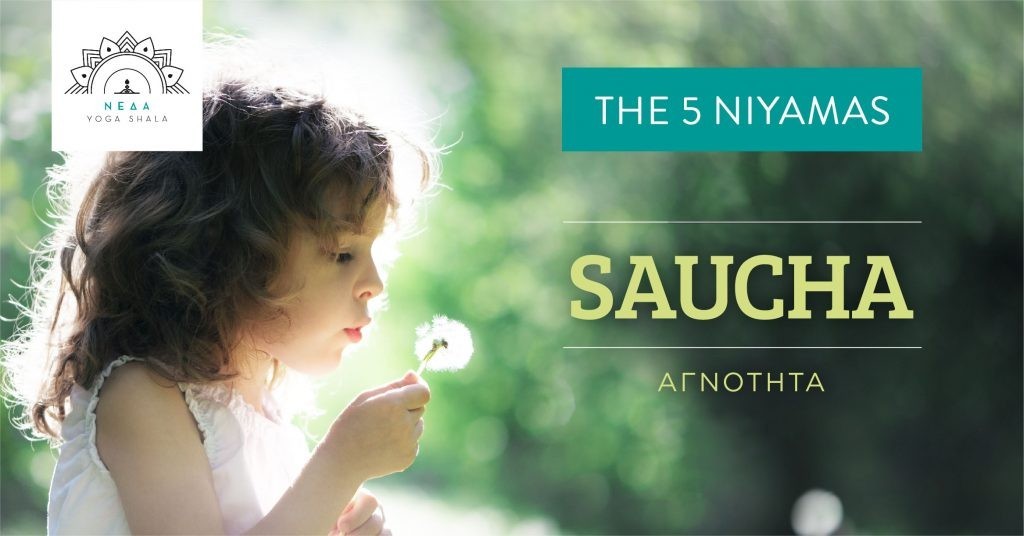
Sausha
Shauca is purity and is the first of Patanjali's five niyamas. The purer something is, the closer it is to its essence. In the ancient text of the yoga sutras, this concept is approached physically, mentally, and spiritually to arrive at the realization of the transience of the body, so that non-attachment to it can be achieved. Specifically, verse 2.40 points out:
"The thirst for the body is the great wound of human life. Therefore, the first sign of establishing purity is that you cease to consider yourself as the body."
In order to discern when something is pure, we need to recognize when something else interferes. The body contains organs that are responsible for cleansing, such as the liver, kidneys, lungs, and systems such as the immune and digestive systems. Their function becomes more constructive when we switch to a conscious diet and consumption. Similarly, nature has its own cleansing and burning mechanisms, and when humans do not respect it, pollute it, and destroy it, nature usually finds a way to restore its balance.
We also encounter the concept of purity in the Bhagavad Gita, on the battlefield. In chapter 16, Krishna separates the divine from the demonic nature of man, ranking purity of heart second, after fearlessness. Comparing the body to the "Field" and the senses to the "five pastures," in chapter 13 Krishna, as the Knower of the "Field" and the "Knower of the Field," uses purity (of mind) to detach from the five senses and distinguish between the material and spiritual worlds as a tool for liberation.
Through meditation, the mind, thoughts, emotions, and ideas are illuminated by observing our patterns and automatic reactions. Through the discipline of the body—keeping it still—we observe our identification with the mind. The role of the observer and the distance it creates immerses us in a broader sense of self, taking into account more aspects of our existence. Thus, thoughts cease to play a dominant role and we regain the freedom and responsibility of our choices. As paradoxical as it may sound, the path to non-attachment to the body and matter passes through it, through awareness. It is not always necessary to do something to purify ourselves; sometimes it is enough to stop doing, thinking, or saying something. The closer we come to self-awareness, the freer we become.
Beyond the physical and mental realm, moving on to the spiritual realm, we encounter the concept of catharsis in ancient Greece. Specifically, in ancient tragedy, it constitutes the final vindication and atonement that has a healing effect, both personally and collectively. The viewer, watching the play and the heroes who face loss and injustice, perhaps processes their own experiences, leading to healing. Allegorically, in meditation, we approach the role of the viewer in our own existence, observing what is happening internally, without being overwhelmed by the desire to do something about it immediately, but allowing it to affect us on a deeper level. Meditation helps reduce anxiety, lowers blood pressure and cortisol levels, and accelerates the body's healing process.
Shauca, or purity/cleanliness, is a function that we encounter in biology, in nature, and if we want, we can be inspired by the idea of purity to become a tool for a more conscious approach to ourselves, beyond our physical form, recognizing that the limits of our body do not separate us from the rest of the world, we are part of society and the universe, and just as we are responsible for our own integrity, we are also responsible for our surroundings.